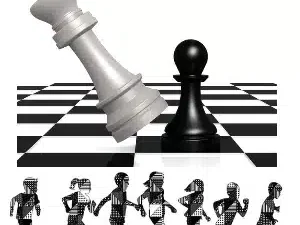
Giant chess game enhances spatial navigational skills in 6-years-old children: preliminary findings

It is now online the Article 

Giant chess game enhances spatial navigational skills in 6-years-old children: preliminary findings

 by Alessia Bocchi, Massimiliano Palmiero, Filippo Persichetti, Maurizio Matteoli, Cecilia Guariglia and Laura Piccardi published in Applied Neuropsychology: Child.

Authors reported results concerning positive effects on spatial ability of the Giant Chess Game in 6-year old children. Children performed as extracurricular activity chess, they learned chess on a giant chessboard. After 10 weeks, at the end of this activity, the group who performed it improved their performance in working memory both in navigational-vista and in reaching space as well as mental rotation skills. These children significantly improved their performance more than other children employed in a standard didactics.

These findings suggest that extracurricular activity like the Giant Chess Game may have a role in contrasting the spreading of navigational deficits in particular of the Developmental Topographical Disorientation.

More from the Blog

The Contribution of Internal and External Factors to Human Spatial Navigation
The editorial "The Contribution of Internal and External Factors to Human Spatial Navigation" by Laura Piccardi, Raffaella Nori, Jose Manuel Cimadevilla, and Maria Kozhevnikov in Brain Sciences is now available online. Spatial navigation involves various cognitive processes such as memory, attention, spatial updating, mental planning, and problem-solving skills. Additionally, internal and external factors like age, […]
A cockpit view of a runway during a night approach, illustrating the visual challenges of the black hole approach
Enhancing Aviation Safety: Understanding the Risks of the Black Hole Approach
Investigating Flight Safety and Visual Illusions in the Italian Aviation Context A significant new study has been released in the journal Aerospace Medicine and Human Performance, shedding light on the physiological challenges pilots face during night operations. The research article, titled The Black Hole Approach and The Italian Experience, was authored by Luigi Cacciapuoti, Laura Piccardi, Marcello […]
Doctor using AI interface, showing healthcare providers' AI awareness.
The I-KAPCAM-AI-Q: A Novel Instrument for Evaluating Healthcare Providers’ AI Awareness in Italy
The I-KAPCAM-AI-Q: A Novel Instrument for Evaluating Healthcare Providers’ AI Awareness in Italy Bridging the Gap in AI Integration for Italian Healthcare Understanding AI Readiness Among Italian Medical Professionals The integration of Artificial Intelligence (AI) into healthcare holds immense promise for improving diagnostics, treatment, and patient care. However, successfully leveraging AI requires a thorough understanding […]
Scroll to Top