

Sapienza University of Rome
Spatial Cognition Lab: independence Begins with Orientation
Welcome to the Spatial Cognition Lab. We study spatial cognition and the cognitive processes behind human navigation across the lifespan — from the internal factors (gender, cognitive style, strategy, experience) to the external ones (landmarks, complexity, scale) that shape how each of us reads the world like an inner compass.
Spatial Cognition Lab at a glance
The Spatial Cognition Lab is a neuropsychology research group at Sapienza University of Rome, led by Prof. Laura Piccardi, that studies how humans orient themselves and navigate space.
Our work on spatial cognition connects cognitive neuroscience, clinical neuropsychology and everyday life: we measure topographic memory, map how people build cognitive maps of cities like Rome, and investigate developmental topographical disorientation (DTD) — getting lost in familiar places without any brain injury. The goal is practical: independence begins with orientation, so better tests and training improve quality of life.
 Laura PiccardiFull Professor, Sapienza University of Rome · Principal Investigator
| Led by | Prof. Laura Piccardi, Sapienza University of Rome |
|---|---|
| Field | Neuropsychology and spatial cognition |
| Core topics | Human navigation, cognitive maps, topographic memory, DTD |
| Key study | "Where am I?" (PLOS ONE): ≈3% of 1,698 young adults showed DTD |
| Methods | Walking Corsi test, virtual-reality mazes, mental rotation, questionnaires |
| Based in | Rome, Italy |
Funded by Associazione Sturge-Weber Italia via Fondazione Telethon · GSA25C003
Spatial Cognition Lab team wins Telethon funding for Sturge-Weber syndrome research
A Sapienza–IRCCS San Raffaele study mapping the neuropsychological profile of a rare disease to build personalised rehabilitation — with heartfelt thanks to families, Associazione Sturge-Weber Italia and Fondazione Telethon.
Discover the projectExplore the Spatial Cognition Lab: four compass points
Latest articles from the Spatial Cognition Lab blog
New findings on navigational memory, cognitive maps and spatial disorientation, written by our team in Rome.
 AI-generated
Featured · 18 October 2026
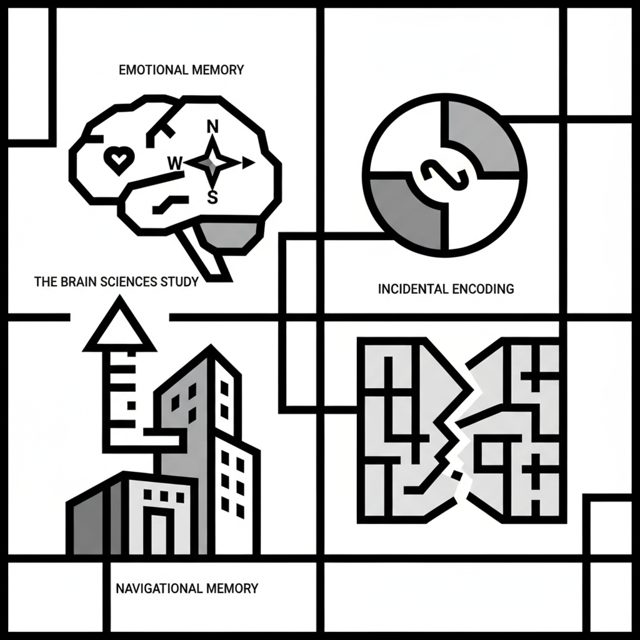
Intentional Versus Incidental Encoding of Emotional and Navigational Memory: The Brain Sciences Study
The article “ Intentional Versus Incidental Encoding of Emotional and Navigational Memory: Preliminary Data in Healthy Young Adults”, by Andrea Di…
Ethical Relativism Mediates the Association Between Openness to Experience and Negative Creativity: How Morality Shapes Creative Thinking
Creativity is traditionally viewed as a valuable resource for human evolution and innovation. However, not all brilliant ideas yield favorable outcomes…
How Misinformation Reshapes Our Navigational Memory and Cognitive Maps
Human memory is notoriously susceptible to suggestion, a phenomenon widely documented in eyewitness testimony. However, a groundbreaking new study…
Lost without a compass?
Developmental Topographical Disorientation (DTD)
If you want to learn more about this condition, if you get lost and want to understand why, or if you would like personalised guidance on the best strategies to reduce its impact on your life, write to us at laura.piccardi@uniroma1.it.
Specialists in the disorder will reply and, if you wish, refer you to the nearest assessment and intervention centre.

3%
of 1,698 young Italian adults showed DTD in our PLOS ONE study "Where am I?".
Call for Papers: open special issues

Our researchers edit special issues on spatial navigation, creativity, emotion and brain health. Submit your work on wayfinding, cognitive maps and orientation.
Read more →Spatial Cognition Lab: frequently asked questions
What does the Spatial Cognition Lab study?
The Spatial Cognition Lab studies how people perceive, remember and navigate space: how cognitive maps form, which strategies people use to find their way, and why some people get lost in familiar places.
What is spatial cognition?
Spatial cognition is the set of mental processes that let us represent where things are, plan routes and keep track of our position — from reading a map to remembering the way home.
What is developmental topographical disorientation (DTD)?
DTD is a lifelong difficulty in orienting in familiar surroundings that appears without any brain injury. In our PLOS ONE study about 3% of 1,698 young Italian adults met the criteria.
Who leads the lab?
The lab is led by Laura Piccardi, Full Professor at Sapienza University of Rome, with a team of neuropsychology researchers and PhD students.
How can I contact the lab?
Write to laura.piccardi@uniroma1.it. Specialists can answer questions about orientation problems and refer you to assessment centres.
Contact the lab in Rome
Rome, Italy