Study Overview and Objective
Now available online: the article "Medical Clinical Minds Meet Artificial Intelligence: Italian
Physicians; Knowledge, Attitudes, and Concordance Between Italian Physicians and AI-Generated
Diagnoses. A National Cross-Sectional Study" by Vincenza Cofini, Mario Muselli, Laura Piccardi,
Eugenio Benvenuti, Ginevra Di Pangrazio, Martina Mancinelli, Eleonora Cimino, Patrizia Palermo,
Emiliano Petrucci, Giovanna Picchi, Loreta Tobia, Arcangelo Barbonetti, Giovambattista Desideri,
Leila Fabiani, Maurizio Guido, Franco Marinangeli, and Stefano Necozione, published in Frontiers
in Digital Health.
Methodology
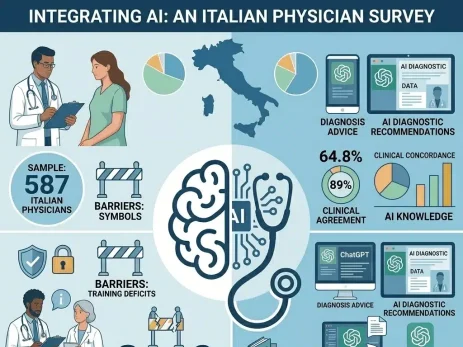
A web-based survey was conducted among 587 Italian physicians. The first part of the questionnaire assessed self-reported knowledge, prior experience, attitudes, and the overall willingness to adopt AI in modern medicine. The second part evaluated the clinical concordance between AI-generated proposals and the physicians' own evaluations of clinical cases processed by ChatGPT.
Key Results and Perceived Barriers
The results revealed that a majority of the participants reported having basic AI knowledge (n = 380, 64.8%), yet they had minimal exposure to formal AI training (18.4%). Currently, only 21.6% reported actively using AI in their clinical practice. Among those AI users, the most familiar application was diagnostic imaging (35.4% of AI users; 7.7% of the total sample).
Despite the interest, significant hurdles remain. The major perceived barriers to AI adoption included a notable lack of training (76.7%) and an underlying resistance to change within the medical community (50.9%).
Diagnostic Concordance with ChatGPT
When presented with a universal clinical scenario, physicians demonstrated the highest agreement with ChatGPT's correct diagnosis compared to incorrect alternatives. For the correct diagnosis, the agreement rate was exceptionally high at 89% [86%–91%], showcasing a strong alignment between human clinical judgment and AI generation.
Conclusion
In conclusion, Italian physicians show a strong interest and enthusiasm for adopting AI tools, despite existing knowledge gaps and limited practical experience. The high concordance between physicians' evaluations and ChatGPT's diagnostic insights strongly suggests the potential for AI-based decision support systems to enhance daily clinical workflows. Ultimately, targeted training programs and robust institutional support are essential to successfully bridge the gap between initial enthusiasm and actual readiness for AI integration in healthcare.