GPS Digital Nudge to Limit Road Crashes in Non-Expert Drivers

It is now available online the article  

GPS Digital Nudge to Limit
Road Crashes in Non-Expert Drivers

 by Nori, R., Zucchelli, M.M., Giancola, M., Palmiero, M., Verde, P., Giannini, A.M. and Piccardi, L. published in Behavioral Sciences
as part of the Special Issue Road Crash Injury and Driver Behavior.

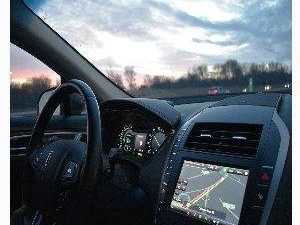
It reports data on the use of the GPS nudge and its relationship with spatial ability, together with its function to support non-expert drivers, in order to reduce the number of road crashes. Our results reveal that the higher the spatial skills are, the greater the GPS use is, and that drivers who use GPS improve their sense of direction. Moreover, people with high visuospatial abilities use GPS more extensively. Finally, young drivers do not consider the GPS aid to be useful when they have no time pressure. Our results have been discussed by taking into account the familiarity-and-spatial-ability model

More from the Blog

Comparing Immersive and Non-Immersive VR_ Effects on Spatial Learning and Aesthetic Experience in Museum Settings
Comparing Immersive and Non-Immersive VR: Effects on Spatial Learning and Aesthetic Experience in Museum Settings
Comparing Immersive and Non-Immersive VR: Effects on Spatial Learning and Aesthetic Experience in Museum Settings A recent article published in Brain Sciences "Comparing Immersive and Non-Immersive VR: Effects on Spatial Learning and Aesthetic Experience in Museum Settings" by Laura Piccardi, Marcello Massidda, Laura Travaglini, Sofia Pescarin, Marco Giancola, Massimiliano Palmiero, Matteo Deflorian, Sabrina Apollaro, Roberta Lista, and Raffaella […]
Relationships between Cognitive Styles and Creativity: The Role of Field Dependence-Independence on Visual Creative Production
It is now online the ArticleRelationships between Cognitive Styles and Creativity: The Role of Field Dependence-Independence on Visual Creative Productionby Marco Giancola, Massimiliano Palmiero, Laura Piccardi and  Simonetta D’Amico, published in Behavio...
Doctor using AI interface, showing healthcare providers' AI awareness.
The I-KAPCAM-AI-Q: A Novel Instrument for Evaluating Healthcare Providers’ AI Awareness in Italy
The I-KAPCAM-AI-Q: A Novel Instrument for Evaluating Healthcare Providers’ AI Awareness in Italy Bridging the Gap in AI Integration for Italian Healthcare Understanding AI Readiness Among Italian Medical Professionals The integration of Artificial Intelligence (AI) into healthcare holds immense promise for improving diagnostics, treatment, and patient care. However, successfully leveraging AI requires a thorough understanding […]
Scroll to Top