

Intentional Versus Incidental Encoding of Emotional and Navigational Memory: The Brain Sciences Study
2 min read
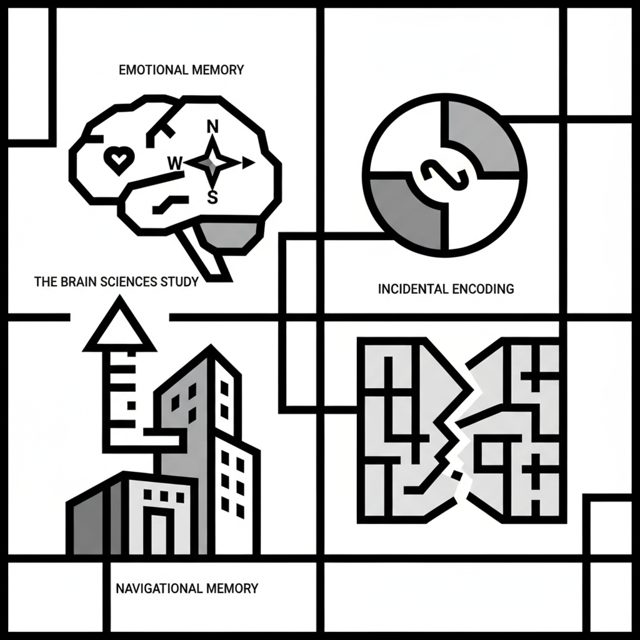 AI-generated
The article “ Intentional Versus Incidental Encoding of Emotional and Navigational Memory: Preliminary Data in Healthy Young Adults”, by Andrea Di Piero, Alessia Bonavita, Laura Piccardi, Maria Casagrande and Cecilia Guariglia, has just been published online in Brain Sciences, an open access journal accessible to readers anywhere in the world.
The study explores a fascinating topic in cognitive neuroscience: how much of what we remember along a route depends on what we are asked to pay attention to.
How the Spatial and Emotional Memory Study Was Conducted
To answer this question, the researchers involved sixty-three young adults. The participants watched a first-person video of a real city route.
Emotional pictures were placed at each crossroad along the journey. Before watching the video, participants were divided into two groups and given different instructions:
- To pay attention solely to the navigation route.
- To pay attention solely to the pictures.
Main Results: The Role of Attention and Emotion
Analyzing the data, the team uncovered very interesting dynamics regarding how our brain encodes spatial and emotional information:
1. The Impact of Attention on Negative and Neutral Images
Explicitly focusing on the pictures significantly improved participants' ability to remember where (the spatial location) negative and neutral images had appeared.
2. The Power of Positivity: Spontaneous Memory
Images with positive content were the exception: they were remembered just as well even without specific instructions (incidental encoding). This suggests that positive stimuli capture and consolidate memory automatically.
3. Route Memory
Surprisingly, memory for the route itself did not benefit at all from the explicit instructions given to the participants.
Clinical Implications and Future Prospects in Rehabilitation
These preliminary findings suggest that positive emotional content enjoys a preferred pathway in our minds, being encoded spontaneously.
This discovery opens important doors for potential future applications, both in clinical assessment and in neuropsychological rehabilitation pathways, particularly regarding aging and spatial memory disorders.
The original article is available in full and open access on Brain Sciences for readers and researchers worldwide.
More from the blog
 AI-generated
Ethical Relativism Mediates the Association Between Openness to Experience and Negative Creativity: How Morality Shapes Creative Thinking
Creativity is traditionally viewed as a valuable resource for human evolution and innovation. However, not all brilliant ideas yield favorable outcomes…
Read more → AI-generated
How Misinformation Reshapes Our Navigational Memory and Cognitive Maps
Human memory is notoriously susceptible to suggestion, a phenomenon widely documented in eyewitness testimony. However, a groundbreaking new study…
Read more → AI-generated
Exploring Early Cognitive Markers in the Alzheimer’s Disease Continuum
A groundbreaking study has just been published in the Journal of Alzheimer’s Disease, offering new hope for the early diagnosis of neurodegenerative…
Read more →